
How long does alcohol stay in your system? Drink-by-drink table
Short answer: your liver removes alcohol at a fixed pace of roughly one UK unit per hour, and nothing can speed it up. A pint of 4% lager takes around 2 hours 40 minutes to clear for an 80 kg man, and about 3 hours 30 for a 65 kg woman. A bottle of wine takes around 10 hours for him and nearly 14 hours for her. Traces last longer than the alcohol itself: up to about 3 days in urine tests and around 3 months in hair.
How your body gets rid of alcohol
Alcohol reaches your blood within 30 to 60 minutes of drinking: faster on an empty stomach, slower with a meal. Your blood alcohol peaks, then starts to fall.
From then on, your liver does almost all the work. An enzyme called alcohol dehydrogenase breaks ethanol down into compounds your body can get rid of. The key point is that it works at a roughly constant rate, not faster when there is more to process. For most people, blood alcohol falls by about 0.15 grams per litre per hour, and by as little as 0.10 for some. In UK terms, the NHS puts it at around one unit per hour for an average adult.
A tiny share of alcohol leaves through your breath, sweat and urine. That is what breathalysers measure, but it does not meaningfully speed up the process.
The table: drink by drink
One UK unit is 10 ml, or 8 g, of pure alcohol. Here is the approximate time from starting to drink to being back at zero, including absorption, for an 80 kg man and a 65 kg woman.
| Drink | UK units | Man, 80 kg | Woman, 65 kg |
|---|---|---|---|
| Single measure of spirits (25 ml, 40%) | 1 | ~1h30 | ~1h50 |
| Small glass of wine (125 ml, 13%) | 1.6 | ~2h | ~2h40 |
| Bottle of beer (330 ml, 5%) | 1.7 | ~2h | ~2h40 |
| Pint of lager (4%) | 2.3 | ~2h40 | ~3h30 |
| Standard glass of wine (175 ml, 13%) | 2.3 | ~2h40 | ~3h30 |
| Pint of strong lager or cider (5%) | 2.8 | ~3h10 | ~4h20 |
| Large glass of wine (250 ml, 13%) | 3.3 | ~3h30 | ~4h50 |
| 3 pints of lager (4%) | 6.8 | ~6h50 | ~9h40 |
| Bottle of wine (750 ml, 13%) | 9.8 | ~9h40 | ~13h40 |
| 5 pints of lager (4%) | 11.4 | ~11h10 | ~15h50 |
| 8 pints of lager (4%) | 18.2 | ~17h30 | ~25h |
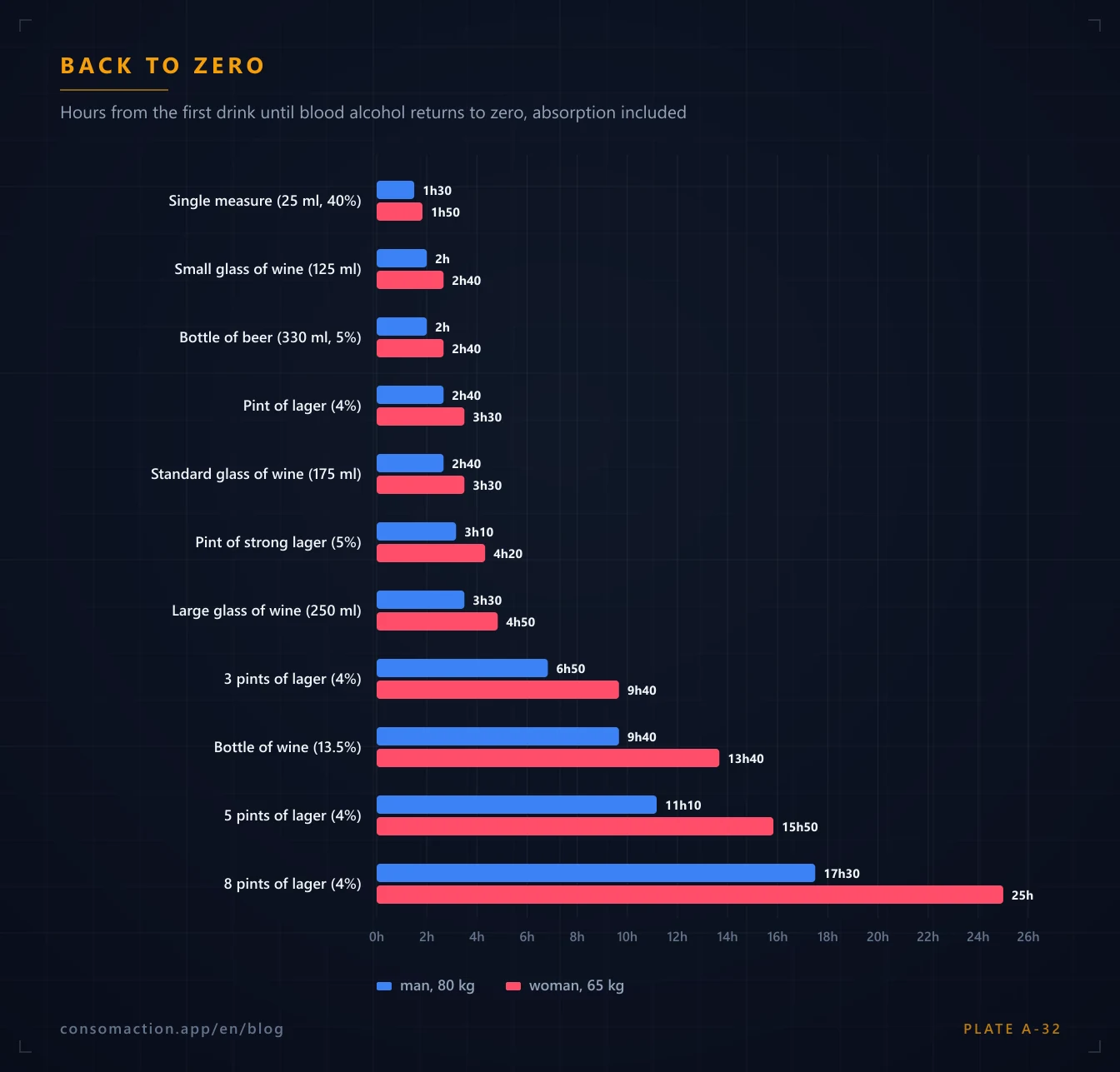
These are estimates based on the Widmark formula and an average elimination rate. If you are a slow eliminator, the times can be up to 50% longer. The times also add up: three pints do not take the same time as one, they take three times as long.
Strength matters as much as volume. A pint of 5% lager contains a quarter more alcohol than a pint of 4%, and a pint of 6.5% IPA holds 3.7 units, as much as one and a half pints of ordinary lager. To check a specific drink, the ConsomAction drinks database gives the exact alcohol content and calories of more than 240 drinks, such as a can of Guinness Draught, an Aperol Spritz or a Carlsberg Elephant.
Why women take longer to clear alcohol
For the same drink, a woman usually reaches a higher blood alcohol level than a man, for two reasons. On average, women have a lower body weight, and a lower share of body water, where alcohol spreads. The same amount of alcohol is diluted in less water, so the concentration is higher, and it takes longer to come down at the same elimination rate.
Other factors move the result too: food in your stomach lowers and delays the peak, drinking fast raises it, and some medicines and liver conditions change how you process alcohol.
Blood, breath, urine, hair: how long can alcohol be detected?
Your blood alcohol falling to zero does not mean every trace is gone. Depending on what is tested, the detection windows are very different:
- Blood and breath: as long as there is alcohol in your blood, which is the time shown in the table above. A breathalyser measures the alcohol that passes from your blood into your lungs.
- Urine: alcohol itself for up to around 12 to 24 hours. Tests looking for ethyl glucuronide (EtG), a by-product of alcohol, can pick it up for up to about 3 days after heavy drinking.
- Hair: EtG builds up in growing hair. The first 3 cm of hair from the scalp reflect roughly the last 3 months (Society of Hair Testing consensus).
In other words: feeling fine does not mean nothing shows.
The morning-after trap
Put the table next to a real night out and the problem becomes obvious. Five pints between 7pm and 11pm can mean alcohol in your blood until around 6am. Eight pints, or a bottle of wine plus a couple of spirits, and you are still processing alcohol well into the morning.
That matters for driving, because the legal limits are lower than most people think: 80 mg per 100 ml of blood in England, Wales and Northern Ireland, and 50 mg in Scotland and Ireland (GOV.UK). We work through three real scenarios in Am I still over the limit the morning after?
Myths that do not work
- Coffee: makes you more alert, but you are exactly as drunk. That can be worse, because you feel able to drive.
- A cold shower or fresh air: same effect. You feel sharper, your blood alcohol does not change.
- Drinking lots of water: good for the hangover, useless for your blood alcohol.
- Being sick: only removes alcohol still in your stomach. What is already in your blood stays there.
- Sleep: lets time pass, which is the only thing that works. It does not make your liver work faster.
FAQ
How long does one pint take to leave your system?
For a pint of 4% lager, count around 2 hours 30 to 3 hours for an average man and 3 to 4 hours for an average woman. A pint of 5% lager or cider takes about half an hour longer.
How long does alcohol stay in your system after a night out?
Roughly one hour per unit, counted from your first drink. After 10 to 15 units, which is an ordinary night out for many people, that means 10 to 15 hours, so alcohol is often still in your blood the next morning.
Can you speed up how fast alcohol leaves your body?
No. Your liver works at a fixed pace. Coffee, water, food and sleep can make you feel better, but only time lowers your blood alcohol.
How long does alcohol show up in a urine test?
Alcohol itself is usually found for 12 to 24 hours. EtG tests, used in some workplaces and treatment programmes, can detect drinking for up to about 3 days after heavy use.