Am I still over the limit the morning after?
Short answer: quite possibly, yes. Your liver removes alcohol at a fixed pace, roughly one UK unit per hour, whether you sleep or not. After six pints finishing at 11:30pm, an 80 kg man is typically back under the England and Wales limit around 4am, but under the Scottish and Irish limit only around 6am, and completely sober around 9:30am. If you are a slow eliminator, add several hours. The only reliable approach is to work out your sober time the night before, before you go to bed.
Why a night’s sleep does not sober you up
Once alcohol is in your blood, your liver breaks it down at a roughly constant rate: about 0.15 grams per litre of blood per hour for most people, and as little as 0.10 for some. In UK terms, that is around one unit an hour, which is also the figure the NHS gives for an average adult.
Nothing speeds this up. Not sleep, not coffee, not a cold shower, not a fry-up. Sleep simply lets the hours pass without you noticing. So the question is never “did I sleep?” but “how much did I drink, and how many hours ago did I start?”
The trap is that you feel fine. A few hours of sleep takes the edge off, the headache is gone after a paracetamol, and you are convinced you are sober. Your blood alcohol does not care how you feel.
The limits: it depends where you are driving
The legal limit is not the same across the UK and Ireland (GOV.UK, Citizens Information):
| Where | Blood limit | Breath limit |
|---|---|---|
| England, Wales, Northern Ireland | 80 mg per 100 ml | 35 µg per 100 ml |
| Scotland | 50 mg per 100 ml | 22 µg per 100 ml |
| Ireland | 50 mg per 100 ml | 22 µg per 100 ml |
| Ireland: learner, novice and professional drivers | 20 mg per 100 ml | 9 µg per 100 ml |
England, Wales and Northern Ireland have the highest limit in Europe. That is set to change: the government’s Road Safety Strategy, published on 7 January 2026, announced plans to lower the limit in England and Wales to 50 mg, the Scottish level, with 20 mg for new drivers (Institute of Alcohol Studies). Until the new rules become law, 80 mg still applies. For the morning after, the lower limits make a big difference: they add around two hours to your wait compared with 80 mg.
Three nights out, worked through
These examples use the Widmark formula, the standard method used by forensic scientists, with an average elimination rate. Times are counted from the first drink.
Friday at the pub. An 80 kg man drinks 6 pints of 4.5% lager between 7pm and 11:30pm (about 15 units).
Dinner and a nightcap. A 65 kg woman drinks a bottle of 13% wine over dinner, then a double gin and tonic, between 7pm and midnight (about 12 units).
A wedding. An 85 kg man has 4 pints of 4.5% lager, 3 glasses of prosecco and 3 double spirits between 6pm and 1am (about 20 units).
| Scenario | Under 80 mg | Under 50 mg | Under 20 mg | Zero |
|---|---|---|---|---|
| Friday at the pub | ~4:05am | ~6:05am | ~8:05am | ~9:25am |
| Dinner and a nightcap | ~5:30am | ~7:30am | ~9:30am | ~10:50am |
| The wedding | ~6:40am | ~8:40am | ~10:40am | ~12:00pm |
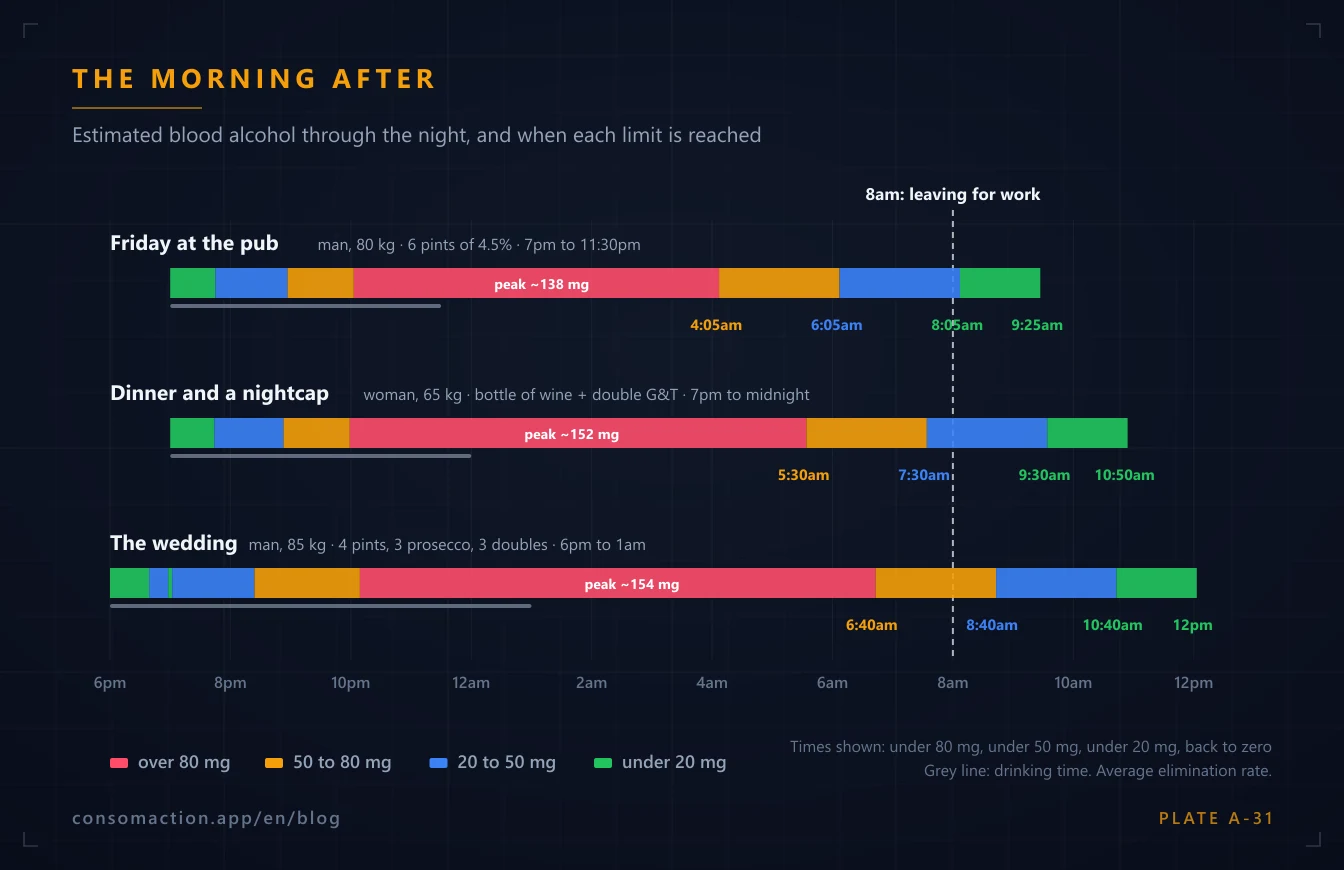
Now look at the wedding guest who sets off at 8am to drive home. In England he is probably just under the limit. In Scotland or Ireland he is over it. And if he is a slow eliminator (around 0.10 g/L per hour), he would only get under 80 mg around 1pm.
These figures are estimates. Your weight, whether you ate, your genetics and how fast you drank all move the result, sometimes by several hours. Use them to understand the scale of the problem, not to plan a drive.
What you risk if you are caught
In England and Wales, driving over the limit means a ban of at least 12 months, an unlimited fine and up to 6 months in prison (GOV.UK). The ban rises to 3 years if you are convicted twice in 10 years. A conviction stays on your licence for 11 years and your insurance premiums will jump.
In Ireland, a fully licensed driver caught between 50 and 80 mg receives a €200 fine and an automatic 3-month disqualification. For learner, novice and professional drivers, the same applies from 20 mg. Higher readings go to court, with longer bans and higher fines.
Morning-after cases are common precisely because drivers do not think they are drunk. The police do not need you to feel drunk: they only need the reading.
How to work out your sober time
The simplest method is to count your units and allow at least one hour per unit, starting from your first drink, then add a safety margin. If you drank 15 units starting at 7pm, do not plan to drive before 10am at the earliest, and later if you are driving in Scotland or Ireland, or if you are a smaller person.
A more precise method takes your weight, sex and actual drinks into account. That is exactly what the ConsomAction calculator does: enter your drinks, and it shows your full blood alcohol curve and the time you will be sober. Do it before bed, set your alarm accordingly, and if in doubt, take the train, a taxi or ask someone else to drive.
FAQ
Can I drive after 8 hours of sleep?
Only if you drank moderately. Eight hours clears around 8 units for an average adult, so after more than that you may still have alcohol in your blood. After 15 units or more, you are likely to be over the Scottish and Irish limits at 7am, and possibly over the England and Wales limit too.
Does coffee or a big breakfast help?
No. Coffee may make you feel more awake, and food may settle your stomach, but neither changes how fast your liver removes alcohol. Only time lowers your blood alcohol.
Are home breathalysers reliable?
Good ones give a useful indication, but cheap models can be inaccurate, and a reading just under the limit leaves no margin for error. If a home test shows any alcohol at all, do not drive.
Is there a safe number of drinks for driving the next day?
There is no universal number, because it depends on how much you drank, when, and on your body. The only rule that always works is not to drive until you have allowed enough time, and when in doubt, to wait longer.