How many pints can I drink and still drive?
Short answer: there is no number of pints that is safe for everyone. As a rough guide, two pints of 4% lager in two hours put an average 80 kg man at around 40 mg of alcohol per 100 ml of blood, under the England and Wales limit of 80 mg. The same two pints can put a 65 kg woman at around 70 mg, over the 50 mg limit in Scotland and Ireland. For Irish learner and new drivers, one pint can be enough to break the 20 mg limit. If you are driving, the only reliable answer is none.
Why there is no simple answer
The legal limit is set in milligrams of alcohol per 100 ml of blood, not in pints. How many drinks it takes to get there depends on:
- How much alcohol is in each pint: a 3.6% bitter and a 5.2% premium lager are very different.
- Your size: the same alcohol is diluted in more body water in a bigger person.
- Your sex: women usually have less body water for their weight, so they reach a higher level from the same drink.
- Food: a full stomach lowers and delays your peak.
- Time: your liver clears roughly one unit an hour, so drinks spread over an evening count less at any one moment than drinks downed quickly.
That is why the THINK! road safety campaign avoids giving a number: two people drinking the same round can end up on either side of the limit.
The limits you are measured against
- England, Wales and Northern Ireland: 80 mg per 100 ml of blood (GOV.UK). A 50 mg limit has been announced for England and Wales but is not yet in force.
- Scotland: 50 mg per 100 ml.
- Ireland: 50 mg per 100 ml, and 20 mg for learner, novice and professional drivers (Citizens Information).
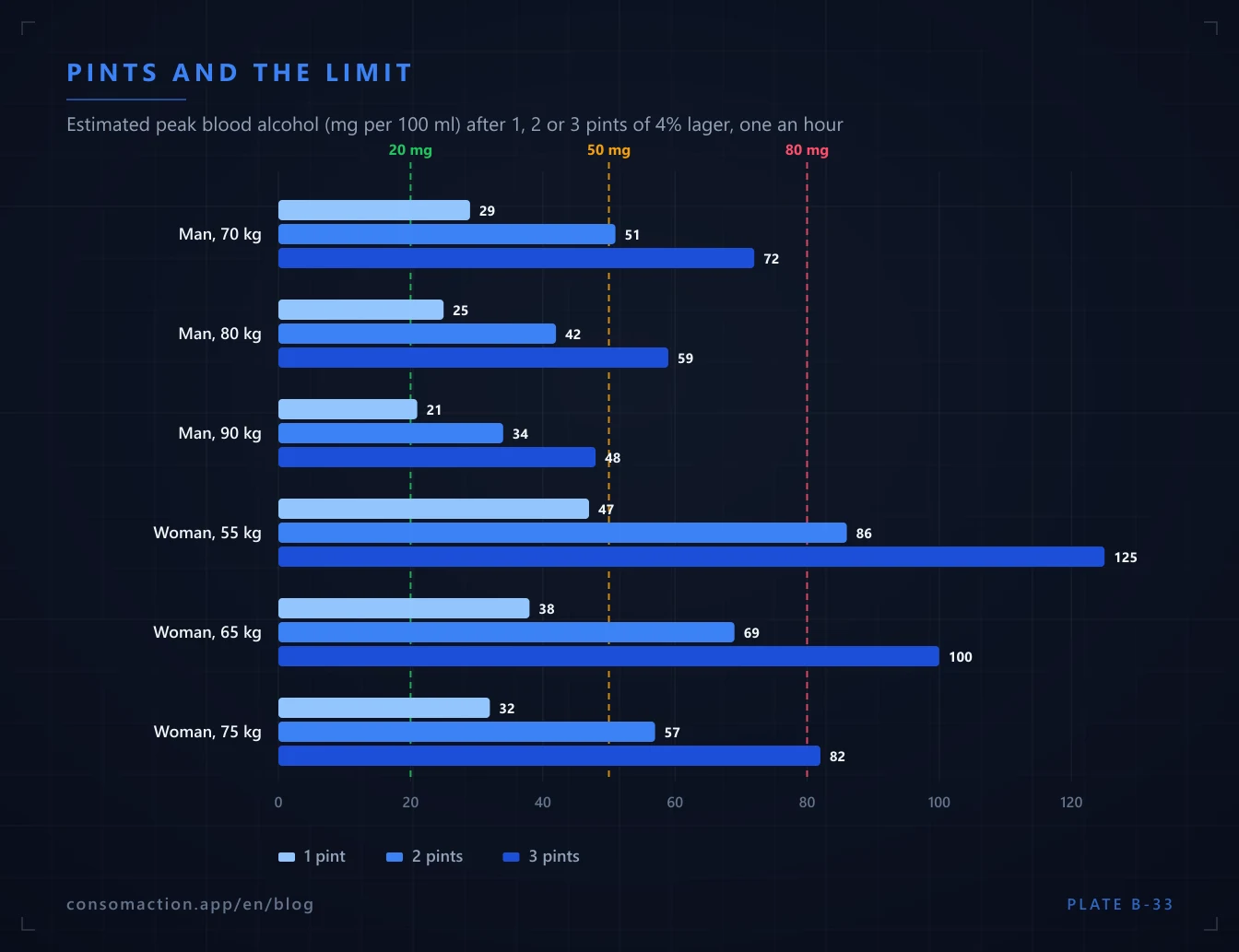
Estimated blood alcohol after 1, 2 or 3 pints
The tables below estimate your peak blood alcohol, in mg per 100 ml, if you drink one pint an hour and eat nothing substantial. They use the Widmark formula and an average elimination rate. Real results can be higher or lower.
Pints of 4% lager (2.3 units each)
| 1 pint | 2 pints | 3 pints | |
|---|---|---|---|
| Man, 70 kg | ~29 | ~51 | ~72 |
| Man, 80 kg | ~25 | ~42 | ~59 |
| Man, 90 kg | ~21 | ~34 | ~48 |
| Woman, 55 kg | ~47 | ~86 | ~125 |
| Woman, 65 kg | ~38 | ~69 | ~100 |
| Woman, 75 kg | ~32 | ~57 | ~82 |
Pints of 5% premium lager (2.8 units each)
| 1 pint | 2 pints | |
|---|---|---|
| Man, 70 kg | ~38 | ~69 |
| Man, 80 kg | ~33 | ~58 |
| Man, 90 kg | ~28 | ~49 |
| Woman, 55 kg | ~60 | ~113 |
| Woman, 65 kg | ~50 | ~92 |
| Woman, 75 kg | ~42 | ~77 |
Read them with the limit that applies to you:
- At 80 mg (England, Wales, Northern Ireland): most men stay under after two pints of ordinary lager, but a smaller woman can be over after two pints, and two pints of premium lager push many people close to the line.
- At 50 mg (Scotland, Ireland): two pints are enough for most women and for lighter men, and one pint of 5% lager can be enough for a small woman.
- At 20 mg (Irish learner, novice and professional drivers): one pint puts almost everyone over.
Under the limit is not the same as safe
The limit is a legal line, not a safety line. Research on crash risk shows that reaction times and judgement start to suffer at levels well below 80 mg, which is exactly why Scotland, Ireland and most of Europe use 50 mg or lower.
There is also the uncertainty in the numbers above. A tired driver, an empty stomach, a stronger beer than you thought or a generous pour can each add 10 to 20 mg. “Two pints should be fine” is how many drivers end up with a 12-month ban.
Wine and spirits: the same maths
The pint is the classic British measure, but the same logic applies to everything. Roughly, in alcohol:
- 1 pint of 4% lager (2.3 units) is about the same as a 175 ml glass of 13% wine, or a little more than a double measure of spirits.
- 1 large glass of wine (250 ml, 13.5%, 3.4 units) is more than a pint of premium lager.
- 1 double gin and tonic (2 units) is close to a pint of 3.6% bitter.
Our UK units table gives the exact figure for more than 30 common drinks.
What to do instead of guessing
- If you are driving, do not drink. Alcohol-free beers are now widely available in pubs and are a genuinely good option.
- If you have had a drink, count your units honestly and allow at least one hour per unit from your first drink before driving. Our guide on how long to wait after drinking has the full table.
- Think about tomorrow too: after a bigger night, you can still be over the limit in the morning, as we show in Am I still over the limit the morning after?
- Get a personal estimate: the ConsomAction calculator uses your weight, sex and actual drinks to show your blood alcohol curve and the time you will be sober.
FAQ
Can I drive after one pint?
Most adults stay under the England and Wales limit after a single pint of ordinary lager. In Scotland and Ireland it is less certain, especially for smaller people and stronger beers. For Irish learner, novice and professional drivers, one pint is likely to put you over the 20 mg limit.
Is it legal to drive after 2 pints?
In England, often, for an average man drinking ordinary lager. For many women, and in Scotland or Ireland, often not. And legal does not mean unimpaired.
Is the limit the same for beer and wine?
Yes. The limit measures alcohol in your blood, whatever the drink. What changes is how much alcohol each drink contains: a large glass of wine has more than a pint of lager.
Can a breathalyser app or home test tell me if I am under?
A calculator or a good home breathalyser gives an estimate, not a guarantee. Use them to realise how much you have had, not to aim just under the limit.
Further reading
- How long after drinking can I drive? UK and Ireland
- Am I still over the limit the morning after?
- How many units in a drink? UK alcohol units table