Drink-drive limit in England and Wales: 80 mg now, 50 soon?
Short answer: the legal limit in England, Wales and Northern Ireland is 80 mg of alcohol per 100 ml of blood, or 35 µg per 100 ml of breath. It has not changed since 1967 and is now the highest in Europe. In its Road Safety Strategy of January 2026, the government proposed cutting it to 50 mg, the level used in Scotland, with a consultation that closed in May 2026. Until a new law is passed, 80 mg still applies. Being caught over it means a ban of at least 12 months.
The current limits
Police can test your breath, blood or urine. The limits are (GOV.UK):
| Test | England, Wales, Northern Ireland | Scotland |
|---|---|---|
| Blood | 80 mg per 100 ml | 50 mg per 100 ml |
| Breath | 35 µg per 100 ml | 22 µg per 100 ml |
| Urine | 107 mg per 100 ml | 67 mg per 100 ml |
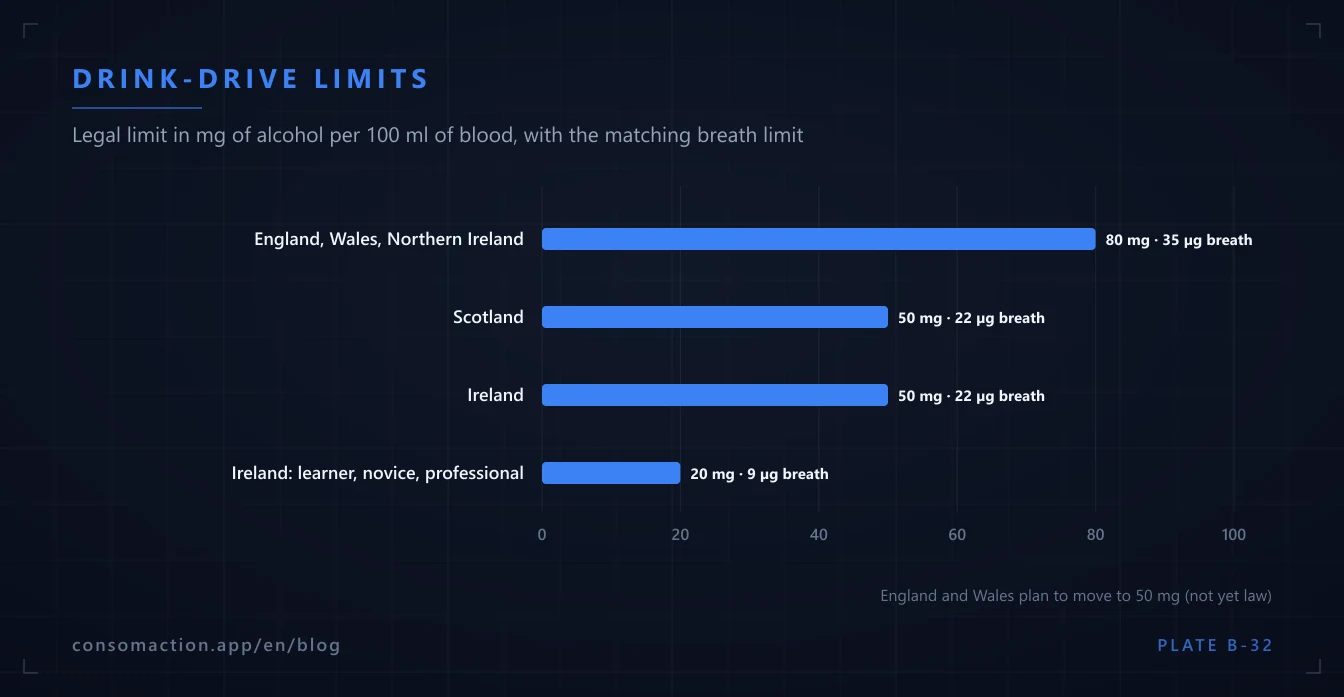
At the roadside, it is almost always the breath test that counts. The 80 mg limit dates back to 1967. Scotland cut its own limit to 50 mg in December 2014, and most of Europe already uses 50 mg or lower. That leaves England, Wales and Northern Ireland with the highest limit in Europe (Institute of Alcohol Studies).
What the government has proposed
On 7 January 2026, the Department for Transport published a new Road Safety Strategy, with a target of cutting deaths and serious injuries on the roads by 65% by 2035. On drink driving, it proposed:
- Lowering the limit in England and Wales to 50 mg of alcohol per 100 ml of blood (22 µg in breath), in line with Scotland.
- A lower limit for new drivers, possibly as low as 20 mg, as in Ireland.
- Alcohol interlocks, devices that stop a car from starting if the driver fails a breath test, for some offenders.
- New powers to suspend the licence of drivers suspected of drink or drug driving while their case is pending.
The public consultation ran until 11 May 2026 (GOV.UK). At the time of writing, the government has not yet confirmed the final limit or the date it would take effect: a change requires new legislation, so check GOV.UK for the latest position.
Why change it?
Drink driving is still a major cause of deaths on British roads. According to Department for Transport figures, 260 people were killed in drink-drive collisions in 2023, alongside more than 6,000 injuries (Institute of Alcohol Studies). The government puts it at around 1 in 6 road deaths (GOV.UK).
Reaction times and judgement are affected well before 80 mg. Supporters of the change also point to public opinion: in the research cited by the Institute of Alcohol Studies, 78% of people favoured some reduction of the limit.
There is a caveat. When Scotland lowered its limit in 2014, a University of Glasgow study found no measurable fall in road accidents, most likely because the change was not backed by more police checks or sustained campaigns (Lewsey et al., 2019). A lower limit works best with enforcement.
What 50 mg would mean in drinks
Under 80 mg, many men can have two ordinary pints and stay under the limit. Under 50 mg, the margin shrinks sharply. Estimated peaks after drinking one pint of 4% lager an hour:
| 1 pint | 2 pints | 3 pints | |
|---|---|---|---|
| Man, 80 kg | ~25 mg | ~42 mg | ~59 mg |
| Woman, 65 kg | ~38 mg | ~69 mg | ~100 mg |
With a 50 mg limit, two pints would put the average woman over, and three would put the average man over. A large glass of wine (3.4 units at 13.5%) would bring many women close to the line on its own. For new drivers, a 20 mg limit would in practice mean not drinking at all before driving. Our guide to how many pints you can drink and still drive has the full table by weight.
The penalties today
In England and Wales, the current penalties are (GOV.UK):
| Offence | Prison | Fine | Driving ban |
|---|---|---|---|
| Driving or attempting to drive over the limit | Up to 6 months | Unlimited | At least 1 year (3 years if convicted twice in 10 years) |
| Being in charge of a vehicle over the limit | Up to 3 months | Up to £2,500 | Possible |
| Refusing to give a breath, blood or urine sample | Up to 6 months | Unlimited | At least 1 year |
| Causing death by careless driving under the influence | Up to life | Unlimited | At least 5 years, plus an extended retest |
On top of that, the conviction stays on your licence for 11 years, your insurance premiums rise sharply, your employer can see it if you drive for work, and it can cause problems when travelling to some countries, such as the United States.
The morning after counts too
Many drink-drive convictions happen the next morning, when drivers feel fine but still have alcohol in their blood. With a 50 mg limit, that risk would grow: after a big night, you can need around two more hours to get under 50 mg than under 80 mg. We work through real examples in Am I still over the limit the morning after?, and our guide on how long to wait after drinking gives the times drink by drink.
The ConsomAction calculator shows your blood alcohol curve hour by hour and the time you will be sober, so you can see where you stand against the limit that applies to you, and the one that is coming.
FAQ
What is the drink-drive limit in England right now?
80 mg of alcohol per 100 ml of blood, 35 µg per 100 ml of breath or 107 mg per 100 ml of urine. The same limit applies in Wales and Northern Ireland.
When will the limit change to 50 mg?
The government proposed it in January 2026 and consulted until May 2026, but a new limit needs legislation. No date had been confirmed at the time of writing.
Is the limit different in Scotland?
Yes. Scotland has used a limit of 50 mg per 100 ml of blood (22 µg in breath) since December 2014.
How many drinks is 80 mg?
There is no fixed number: it depends on your weight, sex, food and the strength of your drinks. Two pints of ordinary lager leave many men under 80 mg but can put a smaller woman close to it or over.
Further reading
- How many pints can I drink and still drive?
- How long after drinking can I drive? UK and Ireland
- Am I still over the limit the morning after?
Sources
- GOV.UK: the drink drive limit
- GOV.UK: drink-driving penalties
- GOV.UK: Road Safety Strategy (January 2026)
- GOV.UK: thousands of lives to be saved under bold new Road Safety Strategy
- Institute of Alcohol Studies: England and Wales are out of step on drink driving (June 2026)
- Lewsey J. et al., drink-drive limit in Scotland: a natural experiment study, 2019